Duplicate Music Finder Tutorials - How to Find and Remove Duplicate Audio Files

Complete Guides to Scanning, Reviewing and Removing Duplicate Music Files Safely

Find Duplicate Songs Tutorial

Please follow this short tutorial to learn the basics of the tool.

You can find detailed information about every feature in the application by pressing F1 on your keyboard. The context-sensitive help will display the help section for the window that is currently displayed.

Do not forget to check also the blog area as it contains a lot of information, tutorials and examples and provides a search option for easier navigation: www.mindgems.com/article/

DOWNLOAD NOW
Compatible with Windows 11/10/8.1/8/7 (Both 32 & 64 Bit)

Duplicate Music Finder Video Tutorial

Watch this Duplicate Music Finder tutorial video to learn how to scan large music collections, compare songs using audio fingerprinting, remove duplicate music safely and organize your music library.

Do not forget to like this video if you want to see more useful content!


How To Find Duplicate Music Files

Start the program. The main window will be displayed.
Find Duplicate Audio Files
Duplicate Music Finder Tutorial

This is a simple tutorial, but if you have difficulties, questions, or doubts you should read: All About Duplicate Cleaner in Windows 11, 10, 8, 7
That article will let you learn all the basics of our duplicate finder tools and let you learn how to confidently get rid of duplicates.

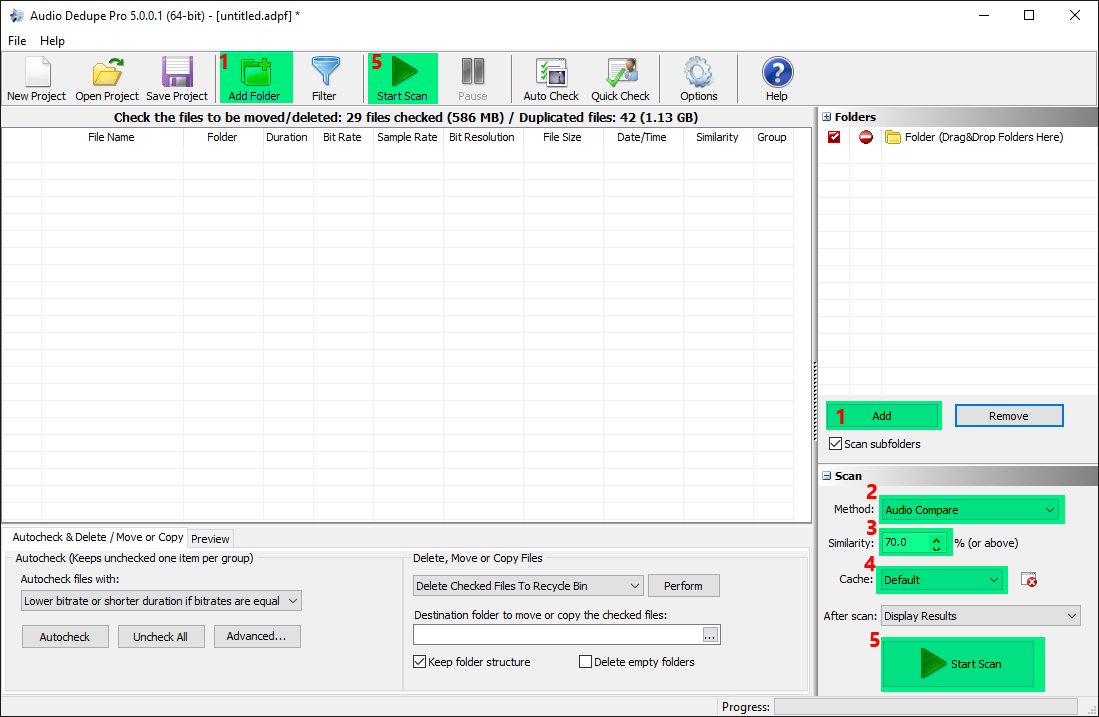
1) Add the folder(s) that will be scanned using "Add Folder" button (1). Folders can also be added by dragging them inside the application from Windows Explorer.
Note: Folders can be excluded from "Auto-check" and "Self scan" using the check-boxes in front of the folder name. Reference the help file for more details.

2) Select "Audio Compare" method from the drop down list (2).
Note: The "100% Identical Files " method does not scan the files for acoustic similarity. Using this method only 100% binary equal files can be detected. "File Size" method will find duplicates with equal file sizes.

3) Adjust the "Similarity" spin button with the desired value (3). The default similarity value is 70%.
Note: Similarity value is used only for the "Audio Compare" method.

4) You should not alter this setting if you are a home user. Cache is set to "<Default>" (4). It holds information for already scanned files.
Note: Using cache files extremely speeds up the the scan for consecutive scans. Even if the files are modified they will be detected and updated in the cache. The cache system is extremely optimized and compact. You can find and change cache location in the settings if needed.

5) Press "Start Scan" button (5)

After the scan process is finished the results list will be displayed:
Duplicate Audio Files Result
Find Duplicate MP3

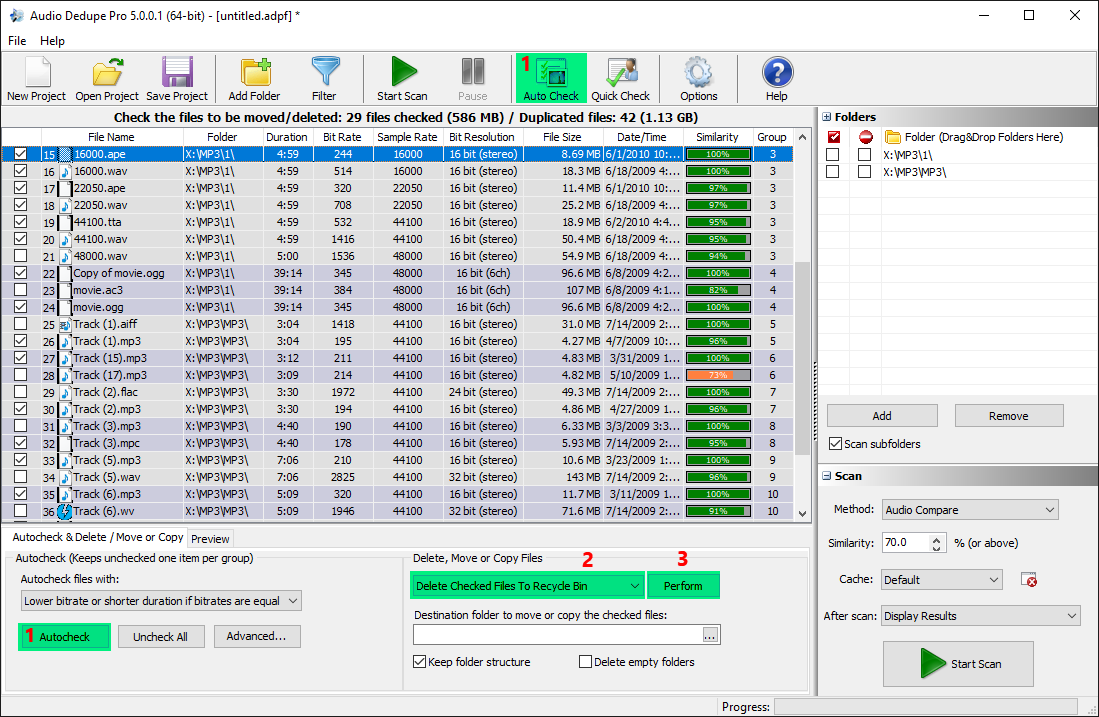
Duplicate audio files are grouped together with alternating group colors. Depending on the "Auto Check " settings, the program can automatically mark files with lower bitrate, shorter duration or smaller file size in every duplicate group. If some files are un/checked manually, the "Auto Check " button (1) can be used to reset the selection.

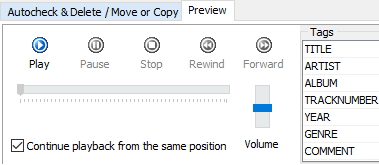
The internal audio player can be used to preview the files. It continues to play from the same position while navigating through the results in order to provide a better comparison.

Audio Dedupe Internal Player and Tag Viewer
find duplicate mp3


After checking the files to be moved, copied or deleted (2) using the "Perform" button (3) will execute the selected action.

The checked files can be deleted the to the Recycle Bin by selecting "Delete files to Recycle Bin" option. The files will be deleted permanently if the "Delete files" option is selected..
The checked files can also be moved or copied to a custom folder which should be set in the "Destination folder..." option. The source file folder structure can be recreated in the target folder if "Keep folder structure" is checked.

The duplicates list supports multiple selection. Multiple files can be selected using the mouse and Ctrl/Shift keys. Note the difference between checked and selected files. The selected files can be removed from the list using Delete key and deleted from the hard drive using the Shift+Delete key.


DOWNLOAD NOW
Compatible with Windows 11/10/8.1/8/7 (Both 32 & 64 Bit)

Duplicate Music Finder Frequently Asked Questions


What is a Duplicate Music Finder?

A Duplicate Music Finder is software that locates duplicate and similar songs in your music library. Unlike ordinary duplicate file finders that compare only file names, sizes or checksums, Audio Dedupe Duplicate Song Finder analyzes the actual audio content using advanced audio fingerprinting. This allows it to find duplicate songs even when they have different file names, bitrates, formats or missing ID3 tags.

How does a Duplicate Music Finder work?

Audio Dedupe creates a unique audio fingerprint for every song and compares the actual sound instead of relying only on metadata. This makes it possible to identify duplicate music files even if they have been renamed, converted to another format or stored with different bitrates.

Can Audio Dedupe compare MP3, FLAC, AAC and other audio formats?

Yes. Audio Dedupe supports MP3, MP2, MP1, MPA, FLAC, AAC, M4A, Apple Lossless, WAV, OGG, WMA, AIFF, AC3, Musepack, WavPack, Monkey's Audio (APE), TTA and many other popular audio formats. It can even find duplicate songs stored in different formats.

Can I find duplicate songs with different file names?

Absolutely. Audio Dedupe compares the actual audio rather than the file name, allowing it to identify duplicate songs even when they have completely different names, locations or folder structures.

Can Audio Dedupe find duplicate songs without ID3 tags?

Yes. Audio Dedupe does not require ID3 tags to identify duplicate songs. Even if metadata is missing, incomplete or incorrect, the software analyzes the music itself to find matching recordings.

What is audio fingerprinting?

Audio fingerprinting is a technology that creates a unique digital signature based on the sound of a recording. Unlike file comparisons or metadata matching, it allows Audio Dedupe to recognize the same song across different formats, bitrates, recording qualities and file names. This tools was tested and ranked as the most precise duplicate music finder.

How do I safely remove duplicate music files?

Audio Dedupe lets you preview duplicate songs, apply automatic selection rules and review every duplicate group before deleting, moving or copying files. This helps ensure that you always keep the best version of each song.

Can I preview songs before deleting them?

Yes. The built-in audio player supports continuous playback, making it easy to compare duplicate recordings and decide which version should be kept before removing any files.

What similarity level should I use?

For most music libraries, the default similarity level provides excellent results. Increasing the similarity percentage finds nearly identical recordings, while lower values can detect different versions, remasters and recordings of the same song.

Can I save my scan results and continue later?

Yes. Audio Dedupe allows you to save duplicate song lists as project files. You can reopen them later and continue reviewing duplicates without scanning your entire music collection again.

What makes Audio Dedupe different from other Duplicate Music Finder software?

Unlike many duplicate music finders that rely mainly on file names or metadata, Audio Dedupe performs true audio analysis using audio fingerprinting. It also includes continuous playback preview, automatic duplicate selection, multiple scan modes and advanced filtering options for professional music collections. Audio Dedupe Duplicate Song Finder was ranked as the best overall Duplicate Music Finder thanks to its outstanding performance, accuracy, and feature set.

Can Audio Dedupe detect the same song stored in different formats?

Yes. The same recording stored as MP3, FLAC, AAC, OGG, WAV or another supported format can still be detected as a duplicate because Audio Dedupe compares the audio content instead of the file format.

Can I find duplicate songs in iTunes or Apple Music folders?

Yes. Simply add your iTunes or Apple Music folders to the scan list. Audio Dedupe can analyze your music files and locate duplicate songs regardless of how they are organized.

Does Audio Dedupe work with large music collections?

Yes. Audio Dedupe is designed to handle large music libraries containing tens or even hundreds of thousands of songs. Multi-threaded processing and cached audio fingerprints help improve performance during future scans.

Can I scan external hard drives and NAS devices?

Yes. You can scan local drives, external USB drives and mapped network drives, making it easy to find duplicate music stored across multiple locations. In addition to that you can use our Free Folder Size Disk Space Analyzer to free up even more space.

Is Audio Dedupe suitable for DJs?

Definitely. DJs often collect multiple versions of the same track from different sources. Audio Dedupe helps identify duplicate songs, extended mixes, remasters and different-quality recordings so you can keep the best copies in your music library.

Can Audio Dedupe find similar songs with different bitrates?

Yes. Audio Dedupe compares the actual audio instead of bitrate or file size, allowing it to identify duplicate songs even when they have been encoded at different quality levels.

Will removing duplicate songs affect my playlists?

That depends on the media player or music management software you use. Before deleting duplicate files, it is recommended to review the duplicate groups carefully and keep the copies that are referenced by your playlists.

How long does it take to scan a music library?

Scan time depends on the number of songs, storage speed and selected scan mode. The first scan analyzes the audio content, while subsequent scans are typically much faster because Audio Dedupe reuses previously generated audio fingerprints whenever possible.

What audio formats and operating systems are supported?

Audio Dedupe supports MP3, MP2, MP1, MPA, FLAC, AAC (including M4A and Apple Lossless), WAV, OGG, WMA, AIFF, AC3, WavPack, Musepack, APE and TTA audio files. It runs on Windows 11, Windows 10, Windows 8.1, Windows 8 and Windows 7, including Windows Server editions, with native 32-bit and 64-bit support.