
Duplicate Image Search: Find Similar Photos By Sample Image
Search Your Own Photo Library Offline - No Uploads, No Cloud
Duplicate Photo Finder runs a duplicate image search across your own drives and folders, finding matching and similar images regardless of format. It supports a huge number of image formats, including 300 RAW camera image formats.
Unlike a standard duplicate finder, Duplicate Image Finder actually looks at photo content to find similarities — so it works even when files have different names, formats, or no matching metadata.
One of its core features lets you find similar images by sample photo — pick a picture, and the tool searches your library for anything that looks like it. It's one of many options in this professional photo organizer. Download it free below to try it yourself.
What Is Duplicate Image Search?
Duplicate image search means finding matching or visually similar photos by using a sample image as your search query — instead of typing keywords or filenames. You point the tool at a photo, and it finds every similar or duplicate version stored across your folders and drives.
This matters most for photos with no useful metadata. If you downloaded pictures from a camera or phone, they likely have no EXIF description or tags. A professional photographer with thousands of untagged wedding or event photos can't just type "Jane Smith Wedding" and expect to find the rest of the shoot. Searching by sample image solves that: the tool analyzes the photo itself and lists every similar image across the folders and drives you select.
How to Run a Duplicate Image Search by Sample Photo
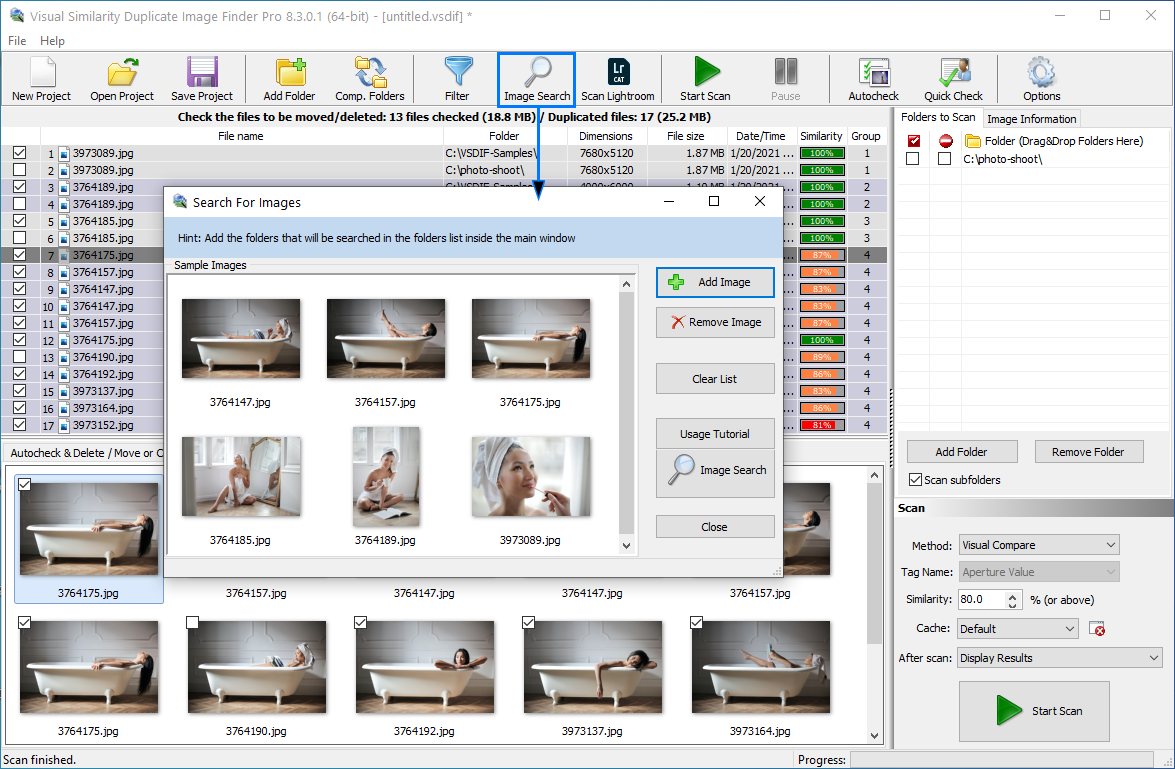
- Add the folders that you want to search in the folders list at the right of the main application window.
- Press the search button and the "Search For Images" dialog will be displayed (see image below).
- Add the sample images that you want to search for.
- Hit the Search button. The results will be displayed in the main application window.
Duplicate Image Search In Action
Duplicate Image Search vs. Reverse Image Search
These terms get used interchangeably, but they solve different problems. Reverse image search (like Google's search by image) searches the open web for a photo — useful for finding where an image came from, spotting stolen photos, or identifying an object or place.
Duplicate image search works the other way: it searches your own local drives and folders, not the internet. Nothing is uploaded anywhere. That makes it the right tool when you want to organize a personal photo library, clean up duplicate exports, or find every photo from a shoot — privately and offline.
What Is Reverse Photo Search and How Does It Work?
A similar image search uses a sample photo as the search query instead of text or voice keywords — the image's own characteristics become the input.
With Google Images, for example, you can quickly find visually similar photos on the web, along with related information like objects, places, or names in the photo.
In technical terms, this is called content-based image retrieval (CBIR) — also known as query by image content (QBIC) or content-based visual information retrieval (CBVIR). It's a form of computer vision applied to image retrieval, which is what Google's search by image uses.
Identifying similar images is simple for a human but computationally difficult — it takes heavy image analysis. A person can compare a few dozen photos by eye, but that same task becomes impossible manually once you're dealing with thousands or millions of images.
Benefits of Using Online Photo Search Engines
Reverse image lookup can be used in many ways. Here are some things you can do by searching with a sample photo:
Detect Identity Theft and Fake Accounts
Use your portrait to find where it's used on the internet. If it's been used as an avatar, every site containing it will be listed — an easy way to spot someone faking your identity.
Learn More About an Object or Product
Use a photo of an object to search the web for information — features, properties, or price. You can even identify a dog's breed just by searching its photo.
Find Visually Similar Images
If you're designing something and need a slightly different version of a photo you have, Google Reverse Image Search can help you discover visually similar or related images.
Search for the Source of an Image
If you have an edited image or one with added text, you can use it to find the original, unedited version online — or track down its license and author.
Find Plagiarized Photos
Use Google's reverse image search to find sites using your photos without permission or credit. You can see exactly how many websites are using a given image.
Create Backlinks for SEO
Once you've found sites using your photos without credit, ask them to link back to your site instead of asking for removal — a simple way to build backlinks and improve your SEO.
Identify Breeds, People, and Places
Search with a photo of a person to find their name — useful for identifying a celebrity and their filmography. Search a photo of a cat to find its breed, or a landmark like the Eiffel Tower to learn its location.
Discover Higher-Quality Versions of a Photo
If you have a low-quality or small image, use it to find other versions online — often turning up a higher-resolution or better copy.
There are countless uses for a reverse image search tool — the above are just a few examples.